Noel Pataki: Soccer Makes The World Feel Smaller
Originally published by Cardinal & Cream
The score was tied 1-1 with a little over 10 minutes on the clock. The Delta State Statesmen had just scored.
I was standing pitchside, taking breaks from shooting photos to bite my nails. Truly a pressure-cooker of a match.
There were several attempted goals from the Union Bulldogs, but none of them could quite find their way into the net. The Statesmen’s defense was fierce.
At least, it was until the 84th minute.
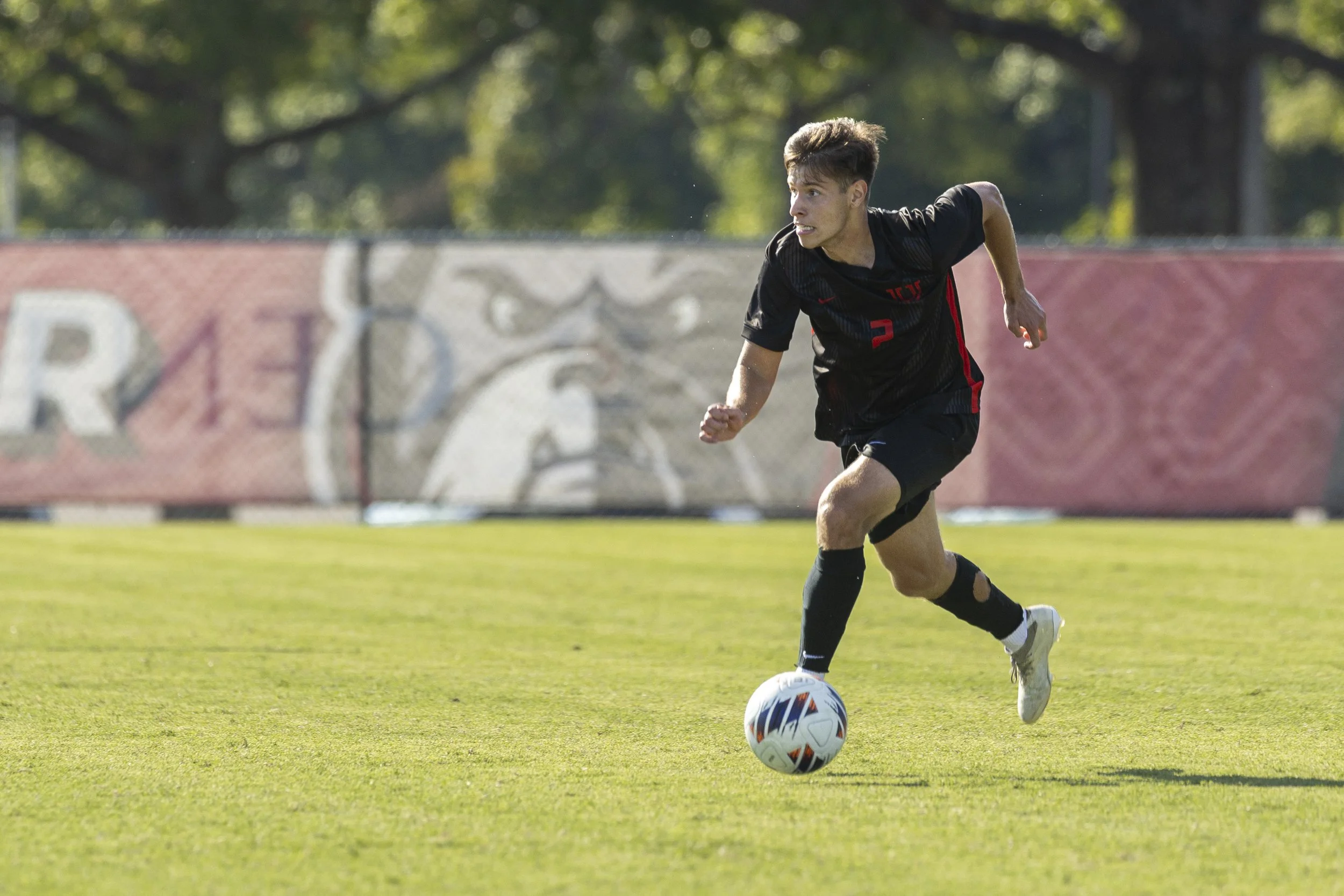
Sophomore business major and starting left midfielder Noel Pataki seized an opening and struck, sending the ball right past the keeper and into the Statesmen’s net. The Bulldogs clinched a win. The boys celebrated. The Family Weekend crowd roared.
“I got to score and I got to help the team. That’s the most important thing,” Pataki said.
This is the mindset that he brings to the pitch.
A good midfielder’s job is to link defense with attacking, using the ability to read the field well. Pataki read the field very well in the match against Delta State.
This isn’t much of a surprise considering that Pataki‘s soccer career started early. He grew up in Hungary, a central European country where the sport is a way of life.
“When I was 12, I moved away from home because I played in a professional academy in my country,” Pataki said. “In Europe, we had all kinds of fields where I played. We had seven or eight grass fields and their only purpose was to play soccer, nothing else. Here, it is quite different.”
Pataki went through the strenuous international recruitment process (also known as loads of complicated paperwork) and was offered an athletic scholarship to Union University. He left his family, friends and comfort zone in Hungary and moved to the United States, a place where soccer looks and feels very different from how it does in Europe.
An everyday soccer (football) match in Europe can only be compared to something like October baseball at Wrigley Field or a Saturday in Knoxville when Alabama’s in town. It’s a part of the culture, a symbol of national identity.
“Everybody lives for soccer,” Pataki said. “You actually live or die for that club.”
In much the same way that soccer is life and death in Europe, American football is king here in the South. It rules every fall Friday night, every Saturday in a college town, and every Sunday after church.
The dynamic of being from Europe and playing soccer in the football-crazed American South is certainly complicated.
“In the U.S., soccer is only growing,” Pataki said.
For Pataki, playing soccer is a connection to home, but being in the U.S. created new challenges that he had to overcome. “I needed to adapt really quickly because obviously I have no other option,” Pataki said.
As important as it is to be adaptable on the pitch, adapting to life in a country that views soccer so differently is even more vital.
“At the beginning, it was hard because of my language,” Pataki said. “My native language is not English — it is Hungarian.”
As he continued to adjust to life in the United States, he made a 4.0 this past semester and discovered a newfound love for country music. His confidence grew on and off the pitch.
Now as a sophomore with a season on the team (and a year of student life in the States) under his belt, Pataki has his eyes set on the playoffs.
Fellow sophomore right-wing striker and Jackson native Solomon Pela shares Pataki’s playoff ambition. Pela had much to say about his confidence in the team and being a mentor to international teammates like Pataki.
“You get different play styles from where they’re from,” Pela said. “It creates a really enjoyable environment, especially in the locker room … because everyone sounds different, everyone listens to different music.”
Pela bragged a bit about Pataki’s specific playing style and what he adds to the team.
“As a teammate, he’s just really good. His technical levels are insane,” Pela said. “That helps everybody else bring up a standard because you don’t want to be lacking … If he’s on left, I’m on the right. I can trust him to cross the ball.”
Trust is essential to the sport of soccer. It’s what coordinates defense, drives offense and keeps the team operating as a unit. Having this team dynamic where everyone makes everyone better is what separates good teams from playoff teams.
Pataki’s long-term goals go further than just the playoffs, however.
“My number one goal right now is to play professionally,” Pataki said.
For someone with skill, work ethic and mindset like Pataki, a professional soccer career seems like an attainable goal. “I don’t know what life’s going to bring me, but I’m ready,” Pataki said.
It’s amazing to me how the game of soccer can unite people from all different countries and walks of life, bringing the whole world into the small town of Jackson, Tennessee.
It’s amazing how an aspiring professional soccer player from Hungary and an aspiring sports journalist from the U.S. can both be fans of the same club, Arsenal, which is based thousands of miles away in London, England.
Soccer is sort of magical in that way, transcending cultures and creeds. They don’t call it “the beautiful game” for nothing.
Soccer makes our big world feel just a little bit smaller.